Author: Rene De Posada

  • Hybrid SDI/IP Live Production Environment – A Software Perspective

    Hybrid SDI/IP Live Production Environment – A Software Perspective

    Watch article preview here: Hybrid SDI-IP Live Production – A Software Perspective.mp4

    A practical breakdown of how a hybrid SDI/IP live production facility operates, covering acquisition, IP transport, switching, monitoring, orchestration, and cloud integration using real-world technologies and workflows.


    The Problem Every Broadcaster Knows

    You’re running a live sports production. Camera feeds are flowing, the director is calling cuts, replay operators are queuing highlights, and somewhere in the chain a timing issue silently impacts a stream. Operators scramble across multiple systems while remote production teams lose visibility.

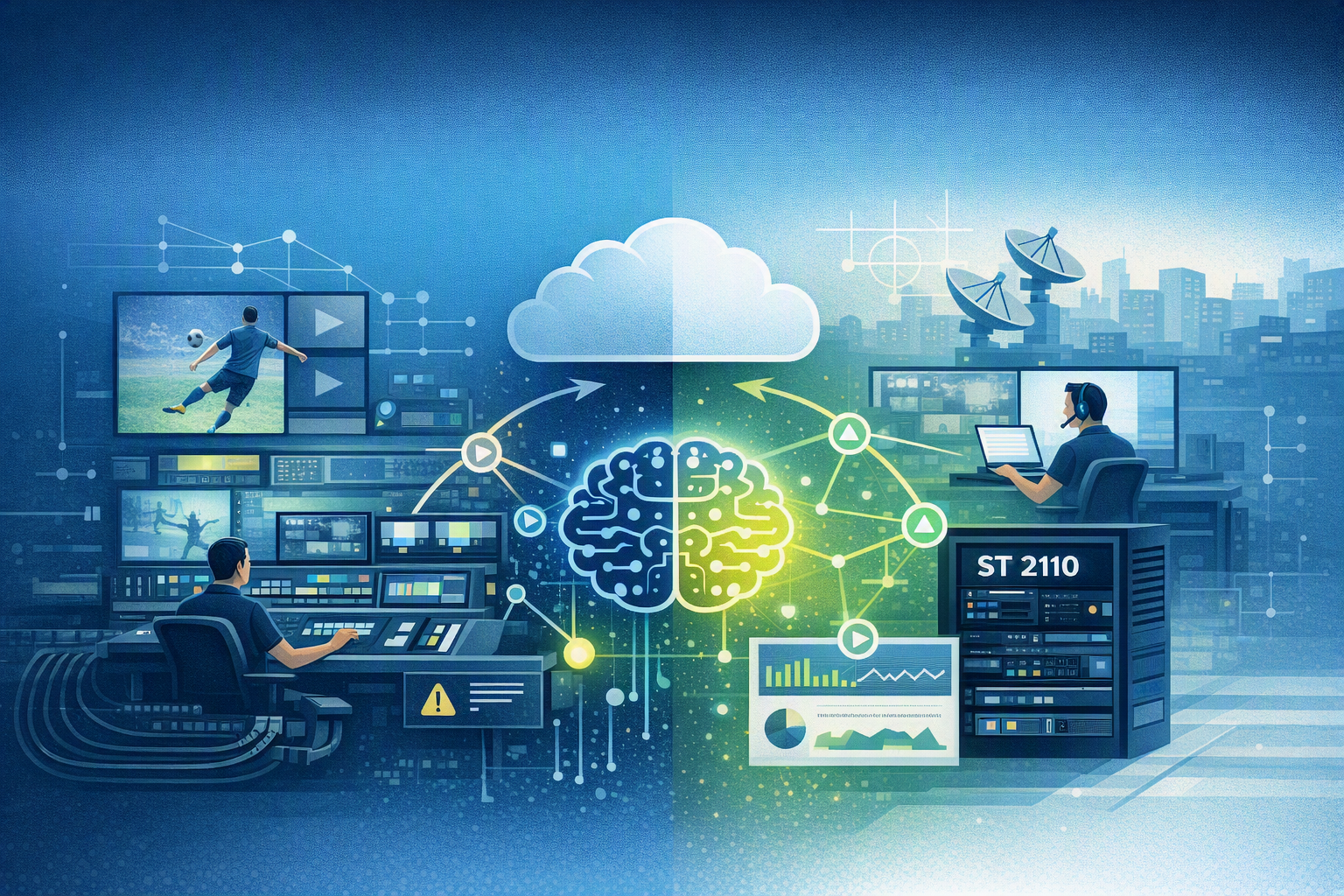
    This is one of the primary drivers behind the industry’s transition from traditional SDI environments to SMPTE ST 2110 IP production. Most broadcasters make this transition gradually, operating hybrid environments for years while balancing legacy infrastructure with newer IP workflows.

    The challenge is not simply transporting video. It is creating operational visibility, orchestration, reliability, and scalability across multiple technology domains.


    The Six Workflow Pillars of a Hybrid Production Facility

    A modern hybrid production environment typically consists of six major domains:

    1. Acquisition
    2. SDI-to-IP Migration
    3. IP Media Network
    4. Live Production & Switching
    5. Monitoring & Multiviewing
    6. Control, Orchestration & Cloud Integration

    The specific technologies referenced throughout this article are representative examples of platforms commonly used to implement these functions. The architectural patterns apply broadly across the industry.


    1. Acquisition: Where the Signal Begins

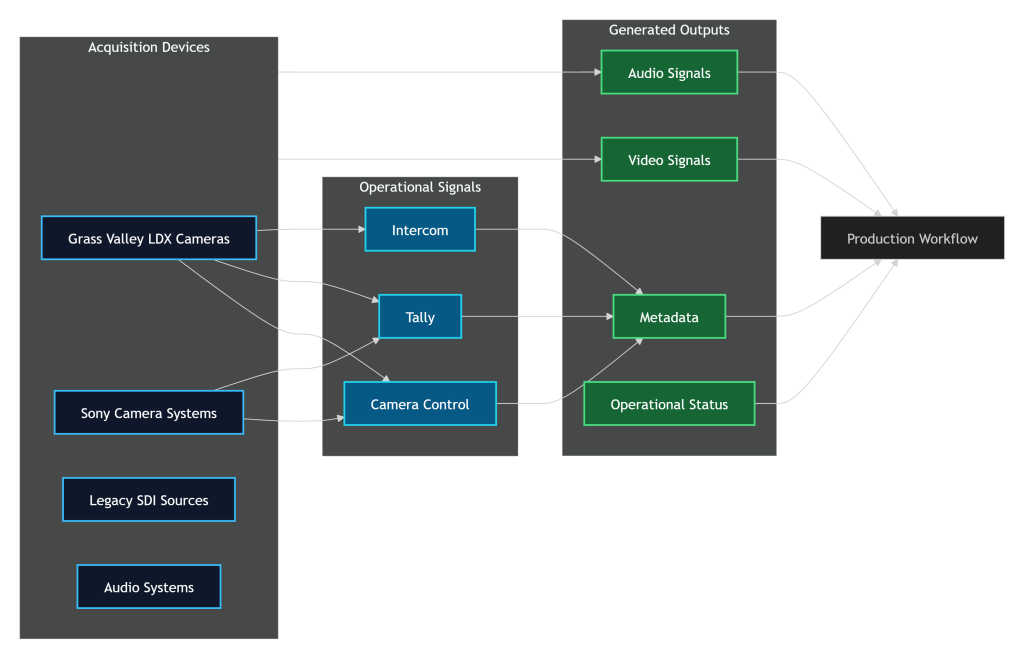
    The acquisition layer captures live video, audio, tally, intercom, and camera control information.

    In hybrid production environments, cameras such as Grass Valley LDX may serve as primary acquisition devices, often paired with systems such as the Grass Valley HPE Hybrid Power Extender.

    Legacy SDI sources, including Sony camera systems and other traditional broadcast equipment, are also commonly integrated into the broader workflow.

    Regardless of vendor, the acquisition layer is responsible for generating the media, metadata, and operational signals that drive the entire production chain.

    For software teams, this means supporting multiple signal formats, control protocols, metadata models, and operational states.

    2. The SDI-to-IP Migration Layer

    One of the most important architectural components in a hybrid facility is the gateway between SDI and IP workflows.

    In these facilities, platforms such as EVS Neuron Bridge and EVS Neuron Convert provide the SDI-to-IP gateway function by transforming traditional SDI signals into SMPTE ST 2110 media flows and handling media format conversions.

    The broader architectural function is media interoperability. These systems allow content to move between legacy infrastructure and modern IP workflows without requiring wholesale replacement of existing equipment.

    The operational impact is significant. A signal that was once tied to a dedicated destination becomes a routable resource available throughout the facility.


    3. The Core IP Media Network

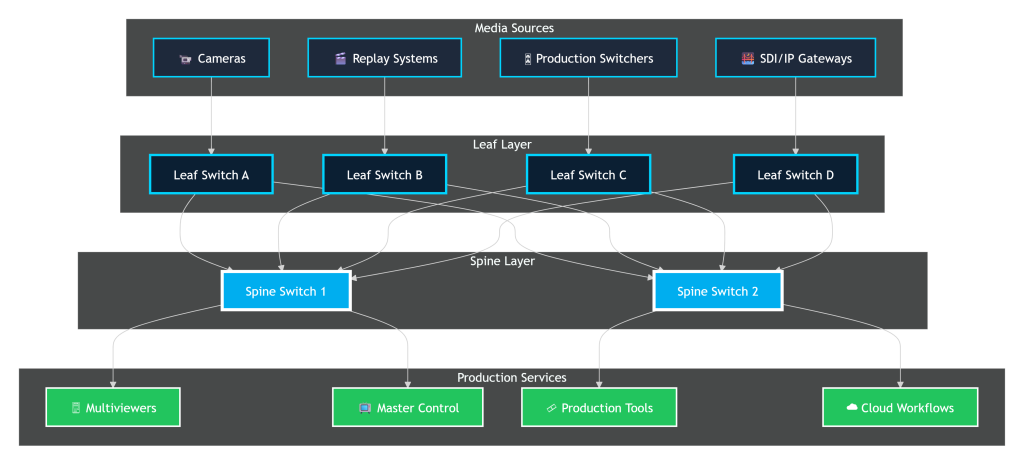
    The heart of a modern IP facility is the media transport network.

    Many modern facilities implement spine-leaf media networks using platforms such as the Arista switching and routing family, providing scalable multicast transport, resiliency, and predictable performance.

    The important concept is not the switch vendor. It is the architectural shift that occurs when the network becomes the media routing platform.

    Routing policies, multicast management, timing synchronization, redundancy, and telemetry become core operational disciplines. For software engineers, the network is no longer supporting infrastructure. It becomes a critical production dependency.

    4. Live Production & Switching

    The production layer is where live content is assembled into the final program output.

    This domain typically includes production switching, replay operations, clip management, graphics insertion, and content distribution.

    In a typical hybrid production workflow:

    • A production switcher such as the Grass Valley K-Frame XP may serve as the primary live switching platform.
    • Replay systems such as EVS XT VIA may provide recording, instant replay, and clip playback capabilities.
    • Production asset management platforms such as EVS IP Director may support clip search, playlist creation, and replay orchestration.

    These products represent specific implementations of broader production functions that exist in every live broadcast environment.

    From a software perspective, this is where latency, resiliency, state management, and operational coordination directly influence on-air outcomes.


    5. Monitoring & Multiviewing

    Operational visibility is essential in IP production environments.

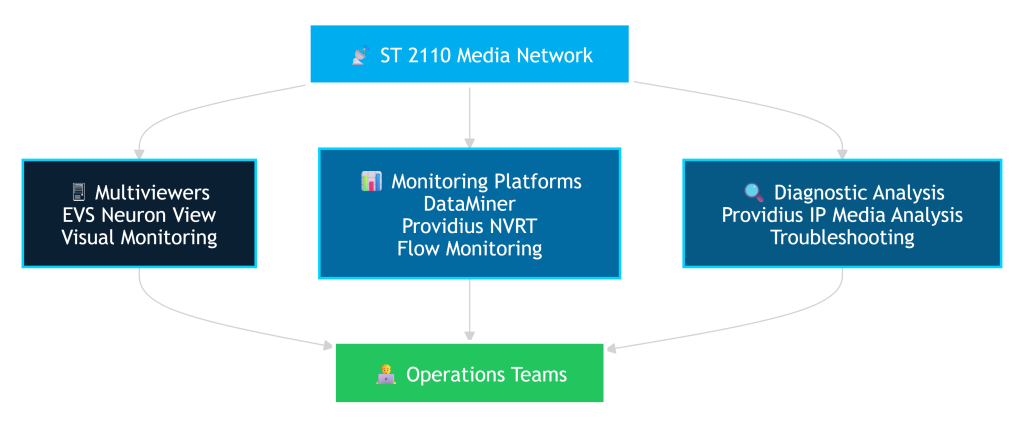
    Facilities deploy multiviewers, media monitoring systems, timing analytics platforms, and deep packet inspection tools to provide real-time insight into media health.

    In many ST 2110 environments:

    • Multiviewer platforms such as EVS Neuron View provide visual monitoring across many media flows.
    • Monitoring systems such as DataMiner and Providius NVRT track ST 2110 flow performance.
    • Diagnostic platforms such as Providius IP Media Analysis provide advanced media analysis and troubleshooting capabilities.

    Together, these types of platforms form the observability stack of the broadcast environment, providing visibility into packet loss, latency, jitter, timing synchronization, and media service health.

    6. Control & Orchestration

    An orchestration layer is often the most important software platform in the facility.

    Rather than requiring operators to work across dozens of independent systems, orchestration platforms provide a unified operational interface for routing, monitoring, switching, replay, multiviewing, and workflow automation.

    In typical multi-vendor broadcast environments, platforms such as Cerebrum and DataMiner provide centralized operational control across multiple vendors and technology domains.

    The broader architectural lesson is that orchestration becomes increasingly important as system complexity grows. It transforms isolated technologies into a coordinated operational platform.
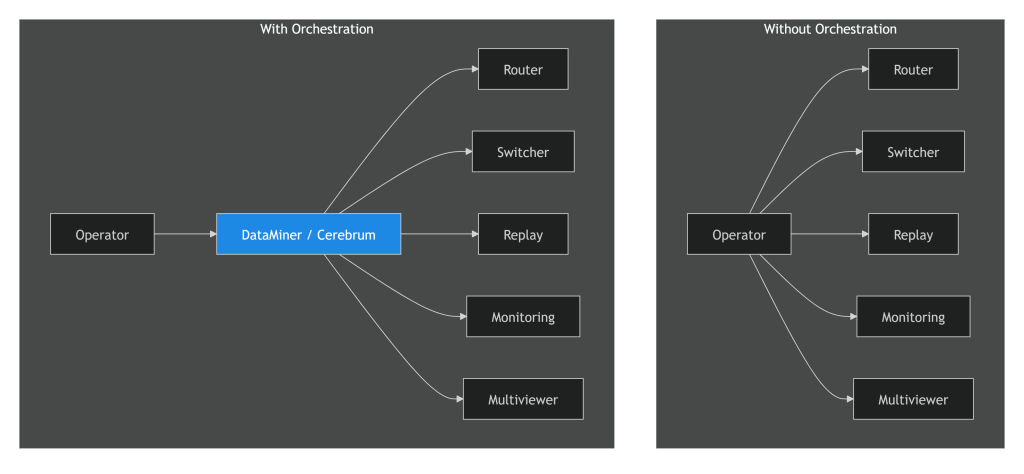
    Orchestration layer for and SDI-IP hybrid production environment.

    7. Cloud Production & Remote Workflows

    Cloud platforms extend production capabilities beyond the physical facility.

    Modern environments increasingly support:

    • REMI workflows
    • Remote operators
    • Distributed production teams
    • Cloud replay
    • Cloud graphics
    • Elastic processing resources

    In many hybrid production architectures, platforms such as Grass Valley AMPP provide cloud production capabilities, while edge systems such as AMPP Edge XL facilitate connectivity between on-premises infrastructure and cloud resources.

    The technology itself is only part of the story. The architectural goal is seamless movement of media, operational workflows, and production resources between edge and cloud environments.


    The Five Dependencies That Can Break Everything

    1. Timing Synchronization: ST 2110 environments depend on accurate timing.
    2. Network Infrastructure: The IP fabric becomes the routing foundation.
    3. Media Gateways: Platforms such as EVS Neuron bridge SDI and IP workflows.
    4. Orchestration Platforms: Systems such as Cerebrum and DataMiner coordinate operations across vendors.
    5. Cloud Connectivity: Platforms such as AMPP and edge integration services enable hybrid production workflows.

    What This Means for Software Engineers

    A modern broadcast facility is not defined by a particular vendor stack. It is defined by how acquisition, networking, production, observability, orchestration, and cloud services work together.

    The technologies discussed in this article provide concrete examples of how those architectural functions can be implemented. Grass Valley, EVS, Arista, Providius, Cerebrum, and DataMiner each contribute capabilities that exist in many forms across the industry.

    Key takeaways include:

    • Observability is non-negotiable.
    • Orchestration scales operations.
    • The network is now core infrastructure.
    • Cloud integration is a workflow, not a feature.
    • Individual products should be viewed as implementations of broader architectural functions.

    Bring Focus Here

    If you’re building or evolving a hybrid production environment, start by understanding the architectural requirements before evaluating technologies.

    Define your observability requirements, document your timing model, establish orchestration boundaries, and determine how cloud workflows fit into your production strategy.

    Consider implementing an end-to-end observability and orchestration platform, such as DataMiner, above the individual technology domains. Many Tier 1 broadcasters adopt this approach because it simplifies the integration of new technologies and reduces operational silos. While vendors often provide their own monitoring and control tools, a centralized platform helps create a unified operational model across the entire ecosystem.

    Technology vendors will continue to evolve. The architectural principles behind reliable broadcast operations remain the same.


    Building software solutions in Media & Broadcast, Satellite, Telecom, or Smart Ecosystems?

    Follow Open xOps for articles, courses, and insights designed for software engineers and technology leaders building and operating complex interconnected systems.

  • The Hidden Cost of Scaling Satellite Connectivity

    The Hidden Cost of Scaling Satellite Connectivity

    Watch the video version of this article here: The Hidden Cost of Scaling Satellite Connectivity.

    Satellite connectivity has quietly become infrastructure. Low Earth Orbit services have dropped the barrier to entry so dramatically that enterprises across logistics, energy, agriculture, and public services are now deploying terminals at a pace that would have been unthinkable five years ago.

    Fast deployment, however, doesn’t equal smart management. And as fleets grow from handfuls of terminals to hundreds, a pattern emerges in organizations that haven’t built the right operational foundation: the connectivity works, but the economics spiral.

    This article isn’t about the technology. It’s about the operational discipline that separates companies that scale satellite connectivity profitably from those that scale it chaotically.


    When Scale Breaks What Used to Work

    Small satellite deployments are forgiving. A team of two can track ten lines in a shared document, catch anomalies manually, and stay on top of billing without much infrastructure. It’s inefficient, but manageable.

    Add a zero to that number and the whole model collapses.

    At scale, the problems compound fast. Data lives in multiple portals. Billing cycles don’t wait for teams to get organized. Contractual constraints — like data allocations locked to individual service lines that can’t be redistributed mid-cycle — mean that mistakes made in week one of a billing period can’t be corrected until the following month. By the time a finance team flags an unexpected invoice, the window to act has already closed.

    What looked like a connectivity project eventually reveals itself as something far more complex: a financial and operational governance challenge that most engineering teams weren’t hired to solve.


    The Blind Spot That Costs the Most

    Ask most operations teams how they monitor satellite consumption and they’ll describe something like an alert system: thresholds, notifications, reactive fixes. A line hits 80% of its cap, someone gets a ping, someone logs in and checks.

    That model has a critical blind spot — it only catches one direction of waste.

    Satellite operations at scale produce two distinct and equally expensive failure modes:

    Overspend happens when a line exhausts its pre-purchased allocation and automatically triggers additional data blocks. The problem isn’t the overage itself — it’s that those top-up blocks are typically priced at a significant premium over pre-purchased capacity. Every automatic recharge is a signal that planning failed, and the penalty is paid in the most expensive data the contract offers.

    Underutilization happens at the opposite end. A line sitting on a large pre-purchased data block that it will never fully consume within the billing cycle represents money that simply expires. There’s no rollover, no refund, and no way to shift that idle capacity to a line that actually needs it.

    Most organizations have dashboards built around overspend. Very few treat underutilization as equally urgent. In reality, idle prepaid capacity can represent just as much financial loss as an overrun — it’s just quieter about it.

    Mature satellite operations monitor both simultaneously, treat each as a meaningful signal, and build their planning models around minimizing waste in both directions.


    The Financial Framing Problem

    Here’s where most technically capable teams still get it wrong: they measure the wrong thing.

    Consumption monitoring in satellite environments is almost always expressed in data volume — gigabytes consumed, percentage of cap reached, projected overage in terabytes. Those are useful operational metrics, but they’re poor proxies for financial impact.

    Consider two scenarios. A line consuming 60% of a 500 GB block has left 200 GB of prepaid capacity unused. A different line consumed its 50 GB block and triggered two automatic recharges. In volume terms, the first line looks fine and the second looks like a problem. In financial terms, the first line may have wasted significantly more money.

    The insight that changes how teams operate is simple: prioritize by cost, not by volume. A small variance on a large, expensive block can outweigh a significant variance on a small, cheap one. When operations teams reframe their monitoring around monetary impact rather than data consumption, their decisions get sharper and their cost outcomes improve.


    Governance as Infrastructure

    The operational challenge with satellite connectivity isn’t just about what data you collect — it’s about how decisions get made from that data.

    In most organizations, the decision chain is informal. Someone notices something, raises it in a chat or a meeting, someone with access makes a change, and the reasoning disappears. No record of what was decided, why, or what the outcome was. No way to learn from the pattern, no way to audit the result, and no accountability trail when the next billing cycle looks different from what was expected.

    Building governance into satellite operations means treating decision-making as a structured process with distinct stages: identify, analyze, recommend, approve, execute, record. Each stage has an owner. Each transition between stages leaves a trail. The person who identifies an anomaly is not necessarily the person who decides how to respond, and the person who decides is not necessarily the person who executes the change.

    This separation sounds like bureaucracy. In practice, it’s the difference between an operation that improves over time and one that keeps making the same expensive mistakes. When every adjustment is traceable — including the ones that were rejected or overridden — the organization builds institutional knowledge instead of just institutional memory.


    Planning Forward, Not Reacting Backward

    The highest-leverage shift any satellite operations team can make is from reactive to predictive.

    Reactive management catches problems after they’ve already cost money. Predictive management catches signals early enough to act before the billing cycle closes. The window is real — with enough historical data and a consistent data collection rhythm, teams can identify trends mid-cycle, project end-of-month outcomes, and make adjustments that take effect for the next period.

    The planning logic isn’t complicated. It starts with an honest estimate of monthly demand by line or by group, informed by historical usage patterns rather than guesses. It then translates that estimate into the most cost-efficient block configuration available under the contract — typically a combination of larger pre-purchased blocks for baseline demand and smaller incremental blocks as a buffer for variability. The goal is to arrive at the end of the billing cycle having consumed nearly all pre-purchased capacity without triggering automatic top-ups.

    Perfect accuracy isn’t achievable. Tight variance is. Organizations that invest in systematic planning consistently outperform those relying on manual reviews, not because they have better data, but because they have a process that uses the data they have.


    What Operational Maturity Actually Looks Like

    For companies serious about getting satellite connectivity governance right, the journey tends to follow a predictable path.

    Stage 1: Consolidation. Bring all data — lines, accounts, consumption, billing — into a single system of record. Eliminate parallel sources of truth. This is foundational and often harder than it sounds.

    Stage 2: Standardized Review. Establish a recurring operational cadence tied to the billing cycle. Mid-month reviews give enough data to detect trends while still leaving time to influence the next period.

    Stage 3: Dual-Direction Monitoring. Instrument both overspend and underutilization. Make idle capacity as visible as overages. Train the team to treat both as action signals.

    Stage 4: Financial Prioritization. Shift reporting from data volume to financial impact. Surface the lines and accounts where monetary risk is highest, regardless of whether the risk comes from too much usage or too little.

    Stage 5: Auditable Decisions. Formalize the decision workflow. Every recommendation, approval, and execution should leave a record that can be reviewed, challenged, and learned from.


    The Strategic Point Most Organizations Miss

    Enterprise satellite connectivity starts as a technical project. A few terminals, a few lines, a monthly invoice that IT signs off on. But as the deployment grows, something shifts.

    The questions stop being technical. They become financial: Is this the right plan composition for this account? Are we paying for capacity we never use? Can we justify this OPEX to the business? They become strategic: Can we scale this model to twice as many sites without losing control of the cost?

    Organizations that recognize this transition early — and build governance structures that match the operational reality of running satellite connectivity at scale — gain a meaningful advantage. They control their costs. They make decisions with evidence. They scale without the chaos that typically follows growth.

    The ones that don’t will keep discovering the problem after the invoice arrives.


    The bottom line: satellite connectivity is no longer a niche capability, and managing it like one is increasingly expensive. The companies that will do this well aren’t just the ones with the best contracts or the fastest hardware — they’re the ones that treat consumption management, financial governance, and operational decision-making as core disciplines, not afterthoughts.

  • Transport the Pixels, Not the Production

    Transport the Pixels, Not the Production

    Watch the video version of this article here: Transport the pixels, not the production.mp4


    Move the output, not the operation.

    For decades, production meant presence. Equipment moved. People traveled. Control followed location.

    Today, pixels move. Everything else stays.

    The Old Constraint: Production Had Gravity

    Traditional production models were built around physical control.

    • Hardware deployed on-site
    • Teams scaled per event
    • Redundancy meant duplication
    • Setup and teardown slowed execution

    This model delivered reliability—but at high cost and low flexibility.

    It doesn’t match how production operates today: distributed, continuous, and demand-driven.

    The Shift: Pixels Over Presence

    Transport the pixels, not the production means:

    • Capture at the edge
    • Process centrally or in the cloud
    • Control from anywhere

    You move video, audio, and metadata streams.
    You stop moving infrastructure. This is the foundation of REMI. But more importantly, it’s the foundation of modern operations.

    Why This Is Happening Now

    Three forces converged:

    • Reliable IP networks → Contribution-grade transport is now viable
    • Software-defined production → Tools run anywhere
    • Operational pressure → More content, faster turnaround, tighter margins

    But one force matters most:

    Production is now inherently multi-site.

    Resources are shared. Teams are distributed. Workflows span locations.

    That creates a new problem: failure is no longer local.

    The Real Shift: From Remote Production to Resilient Production

    Moving pixels solves geography.

    It doesn’t solve reliability.

    When production depends on:

    • Multiple WAN links
    • Distributed control systems
    • Shared infrastructure

    Then a network issue is no longer an inconvenience.

    It’s a production outage.

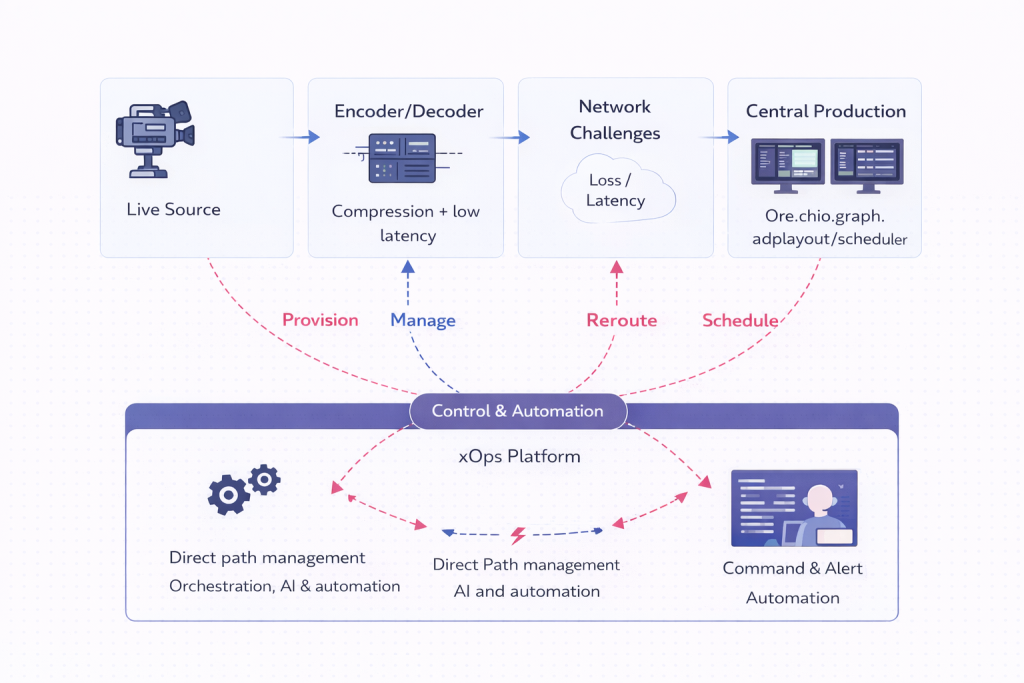
    The Emerging Pattern: Detect → Decide → Act

    Across the industry, a consistent architecture is taking shape:

    1) Detect

    Monitoring systems identify:

    • WAN degradation
    • Link failure
    • Signal anomalies (this is accelerating with AI)

    2) Decide

    A control plane evaluates:

    • Available paths
    • Service dependencies
    • Recovery options

    3) Act

    The system executes:

    • Network rerouting
    • Configuration changes
    • Failover workflows

    All in seconds. Without human intervention.

    This pattern existed long before AI became mainstream; today, some of it is simply being rebranded through an AI lens.

    What This Looks Like in Practice

    A modern REMI-ready architecture introduces a critical capability:

    Automated recovery across distributed systems.

    Example pattern (generalized):

    • Monitoring platform detects a WAN failure
    • Control plane triggers an orchestration workflow
    • Network infrastructure reconfigures routing dynamically
    • Traffic shifts to a healthy path
    • Production continues uninterrupted

    This is no longer experimental. It’s becoming baseline expectation for multi-site production environments.

    Architecture: The New Production Stack

    Edge (Capture)

    • Cameras, microphones
    • Lightweight encoders
    • Minimal on-site footprint

    Core (Production)

    • Switching, graphics, replay
    • Centralized or cloud-based systems
    • Shared across events and locations

    Network (Critical Layer)

    • Multi-WAN connectivity
    • Deterministic transport
    • Redundant paths

    Control Plane (The Differentiator)

    • Observability across domains
    • Service-aware orchestration
    • Automated failover logic

    The Real Challenge: Operating the System

    The complexity isn’t video.

    The complexity is coordination.

    You’re managing:

    • Network behavior
    • Application performance
    • Production workflows
    • Infrastructure dependencies

    All at once. This is where most organizations struggle—not because of technology, but because of lack of system thinking.

    Where xOps Comes In

    REMI at scale requires xOps principles.

    1) End-to-End Observability

    You must see:

    • Network health
    • Stream integrity
    • Service performance

    In one place, in real time.


    2) Cross-Domain Correlation

    You must connect:

    • Network events → Production impact
    • Infrastructure metrics → Service degradation

    Because no failure exists in isolation.


    3) Automation First

    Manual intervention breaks at scale.

    You need:

    • Predefined failover paths
    • Policy-driven routing
    • Self-healing systems

    4) A Strong Control Plane

    This is the backbone.

    A mature control plane enables:

    • Multi-vendor orchestration
    • Service modeling
    • Real-time decisioning

    Without it, distributed production is fragile.

    The AI Question: Enhancement, Not Replacement

    AI is entering the conversation:

    • Detecting anomalies
    • Suggesting actions
    • Generating configurations

    But production environments prioritize predictability over novelty.

    Today, the highest value lies in:

    • Deterministic workflows
    • Pre-modeled recovery scenarios
    • Proven automation paths

    AI will assist—but strong system design will lead.

    Vendor Landscape: Where to Start

    Disclaimer: Open xOps does not endorse or recommend specific products or platforms. The selection of technology solutions remains the responsibility of the technology advisor or organization, who must evaluate and choose the options that best align with their specific business objectives and operational requirements.

    If you’re building toward this model, focus on capabilities—not tools. That said, here’s how the ecosystem currently maps:

    Orchestration & Control Plane

    • DataMiner (By Skyline Communications)
      Cross-domain orchestration, service modeling, and automation backbone

    Network Infrastructure

    • Arista Networks
      Programmable switching, strong automation support, deterministic behavior

    Monitoring & Observability

    • Providius
      Network-aware detection and alarming
    • PRTG
      Broad infrastructure visibility
    • Grass Valley Orbit
      Broadcast-centric monitoring and control

    Production Platforms (Core Layer)

    • Grass Valley AMPP
      Cloud-based production services and workflows
    • Emerging cloud-native vendors continue to expand this space

    What Decision Makers Should Do

    Start simple. Think long-term.

    1. Design for failure first
      Redundancy + automated recovery is non-negotiable
    2. Separate capture from control
      Keep the edge light. Centralize intelligence
    3. Invest early in observability
      Visibility is the foundation of trust
    4. Standardize your workflows
      Repeatability enables scale
    5. Adopt a system mindset
      Integration—not tools—is your real product

    Final Thought

    Transporting pixels is not a feature.

    It’s an operating model:

    • From presence → control
    • From hardware → systems
    • From manual → automated
    • From isolated → interconnected

    And the teams that embrace that model won’t just produce remotely— they’ll operate with resilience, speed, and scale.

  • The Operational Control Plane for Media Contribution

    The Operational Control Plane for Media Contribution


    Disclaimer: Open xOps does not endorse or recommend specific products or platforms. Any references are based on field observations and the presence of these technologies across publicly available case studies and real-world implementations.

    What are we solving for?

    Most reliability strategies in media are solving the wrong layer. How do you measure and control reliability in live contribution—operationally, not theoretically?

    Live contribution failures rarely start at the encoder, and they almost never get solved there either. Reliability in media is an operational problem, not a compression problem.

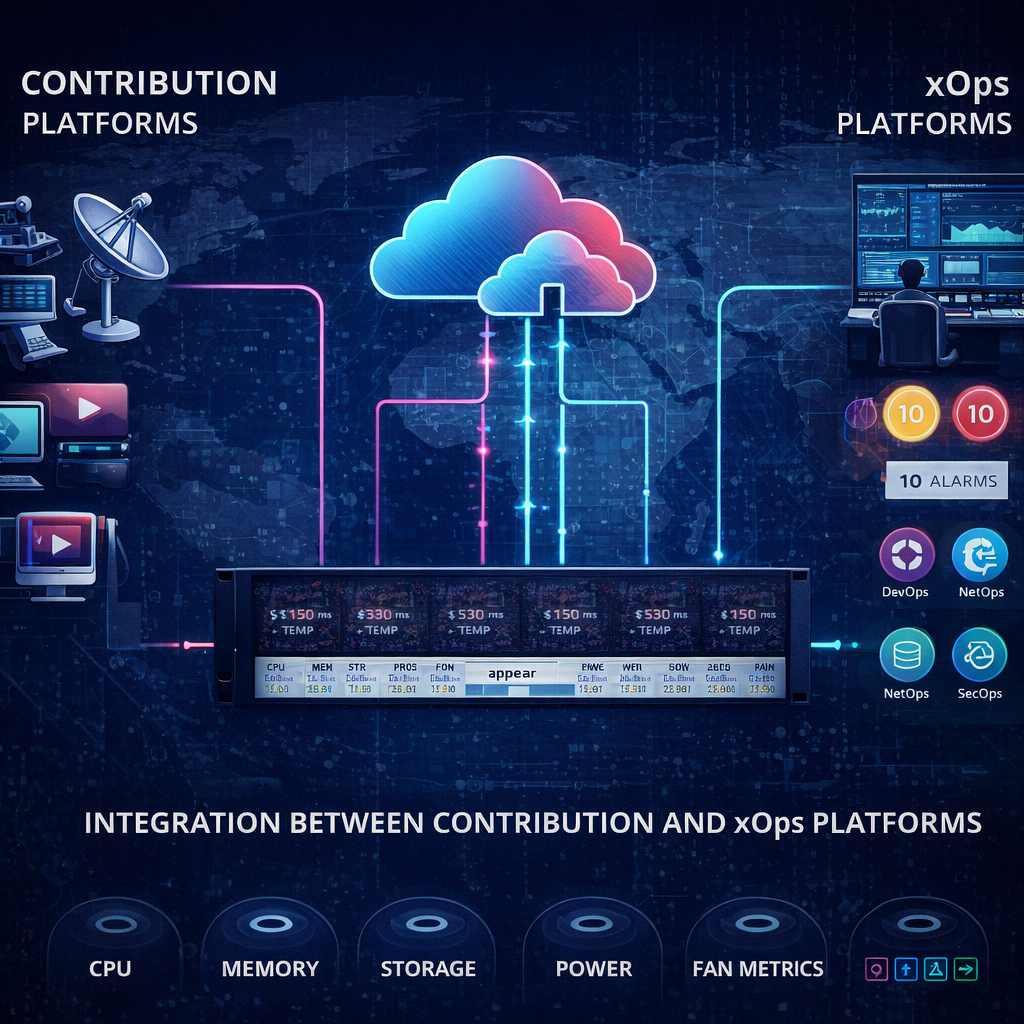
    This article outlines how to integrate contribution systems with software-defined xOps platforms so that contribution becomes a managed, visible, and schedulable service.


    Setting the stage

    How do we move media with the lowest latency and highest quality?

    • Contribution platforms (e.g., Appear X) are purpose‑built for live events, enabling broadcasters to deliver immersive, high‑quality viewing experiences with near‑real‑time latency.
    • These platforms support remote and distributed production workflows, allowing broadcasters to reduce on‑site infrastructure and personnel while preserving production quality and operational resilience.
    • Their compression technologies are optimized for live workflows, enabling high‑quality video transmission with ultra‑low latency and efficient bandwidth usage—critical for time‑sensitive live events.
    • Hardware‑accelerated SRT, integrated directly into the platform, allows broadcasters to reliably transport media over IP networks while mitigating packet loss, jitter, and network instability.

    How do we know it’s working? How do we act when it isn’t? How do we automate this at scale?

    • xOps platforms (e.g., DataMiner) are end‑to‑end software stacks that provide observability, orchestration, automation, scheduling, and AI‑driven analytics across heterogeneous media and network environments.
    • By integrating with specialized contribution platforms and surrounding systems, xOps systems deliver full observability across the entire service chain, not just within individual devices or workflows.
    • The xOps software stack tracks critical metrics and workflows in real time, before and after contribution stages, enabling operators to understand service health in context rather than in isolation.
    • This contextual insight allows teams to detect issues early, correlate faults across domains, and take corrective action—manually or automatically—before media quality or SLA commitments are impacted.
    • At scale, xOps systems enable policy‑driven automation, turning operational intent (for example, protecting latency, uptime, or redundancy) into repeatable, system‑wide actions across multiple live services.

    Mental Model Diagram

    The diagram below outlines a high-level media contribution flow, where specialized systems integrate to deliver streams from source to production.


    Monitor – What Do We Need to Know, Operationally?

    QuestionExample KPIs
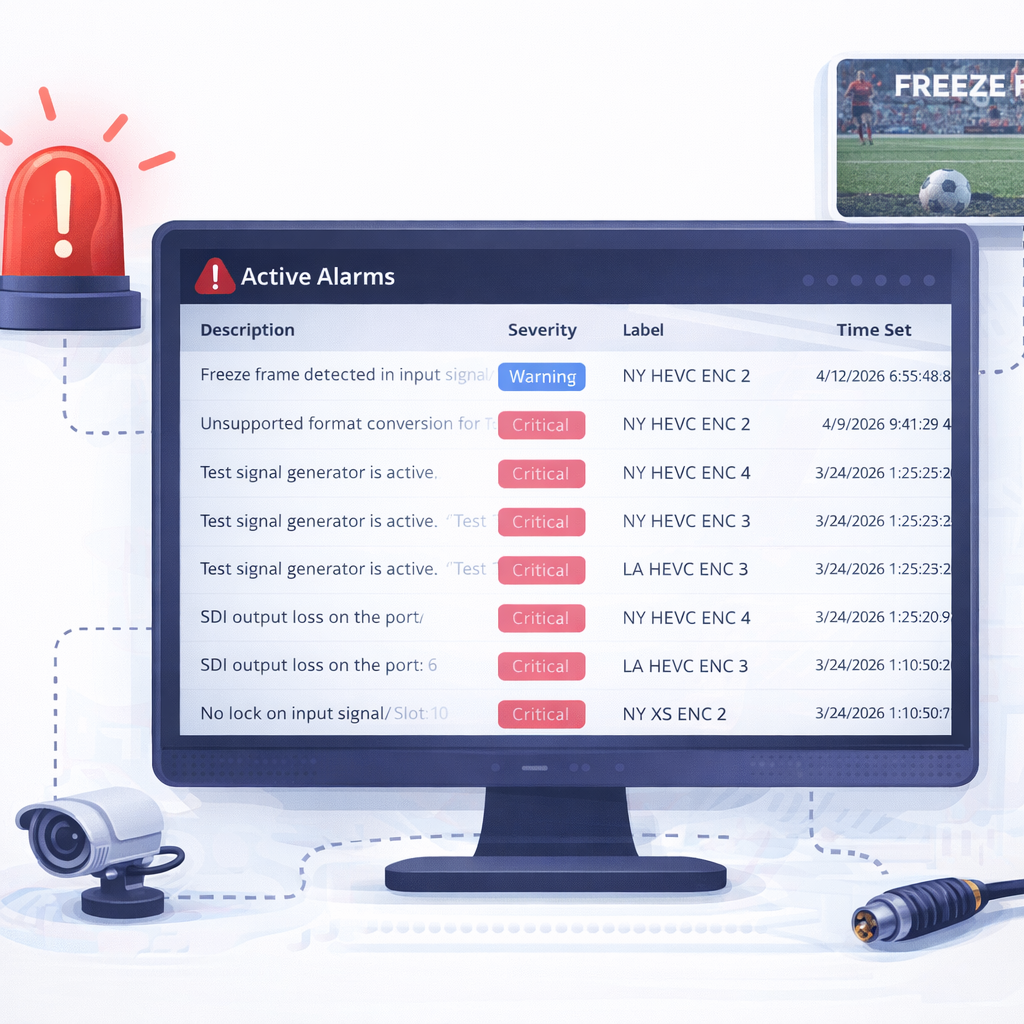
    Is media flowing?Input lock, freeze-frame detection
    Is quality degrading?Compression errors, jitter, packet loss
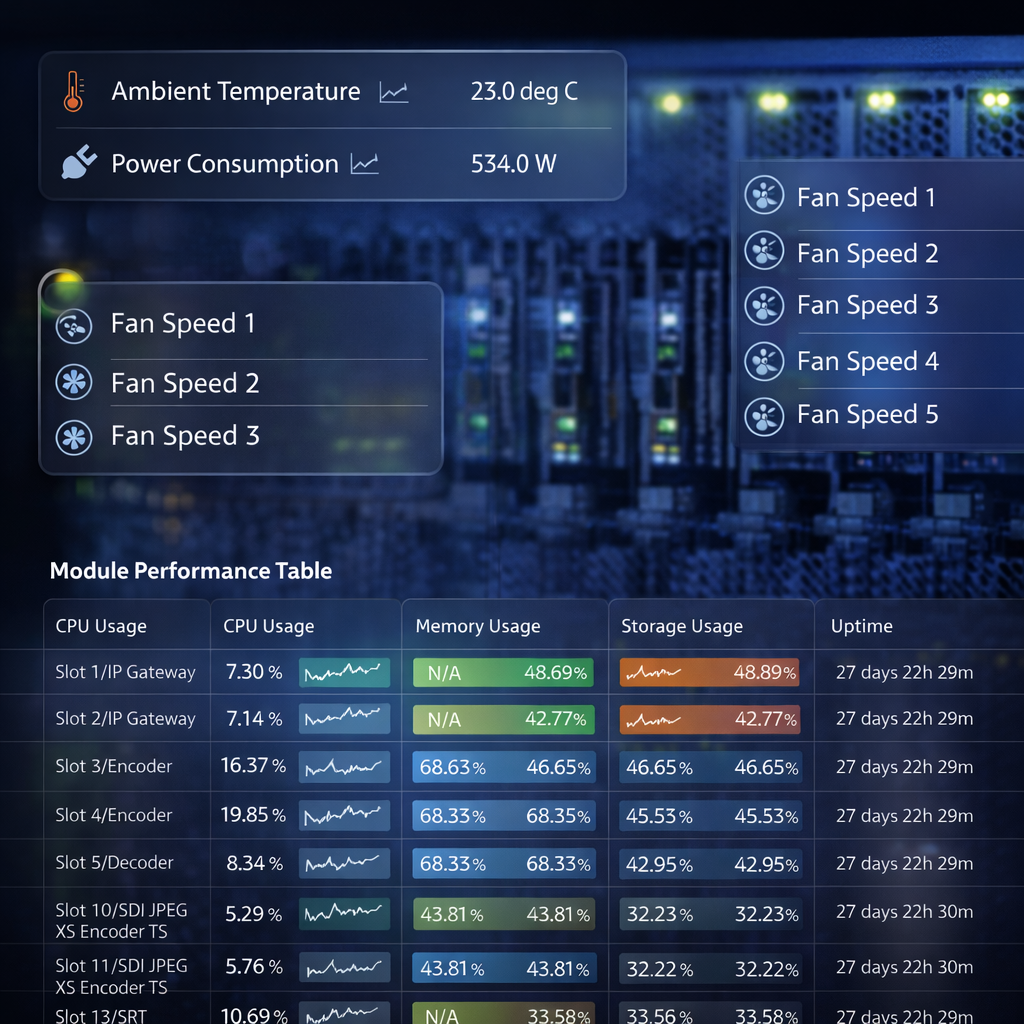
    Is hardware healthy?Temperature, power, fan speed
    Is the service reliable over time?Trends, anomaly detection

    To answer these questions in real time, specialized media contribution platforms (e.g., NetInsight) use an API‑first approach, exposing rich telemetry and control interfaces. The role of the monitoring and control plane (e.g., DataMiner) is to contextualize that data, filter out noise, and surface what truly matters, enabling fast, clear, and actionable operational decisions.

    Is media flowing? Is quality degrading?

    Contribution xOps - Monitoring

    Is hardware healthy?

    Contribution xOps - Monitor Hardware

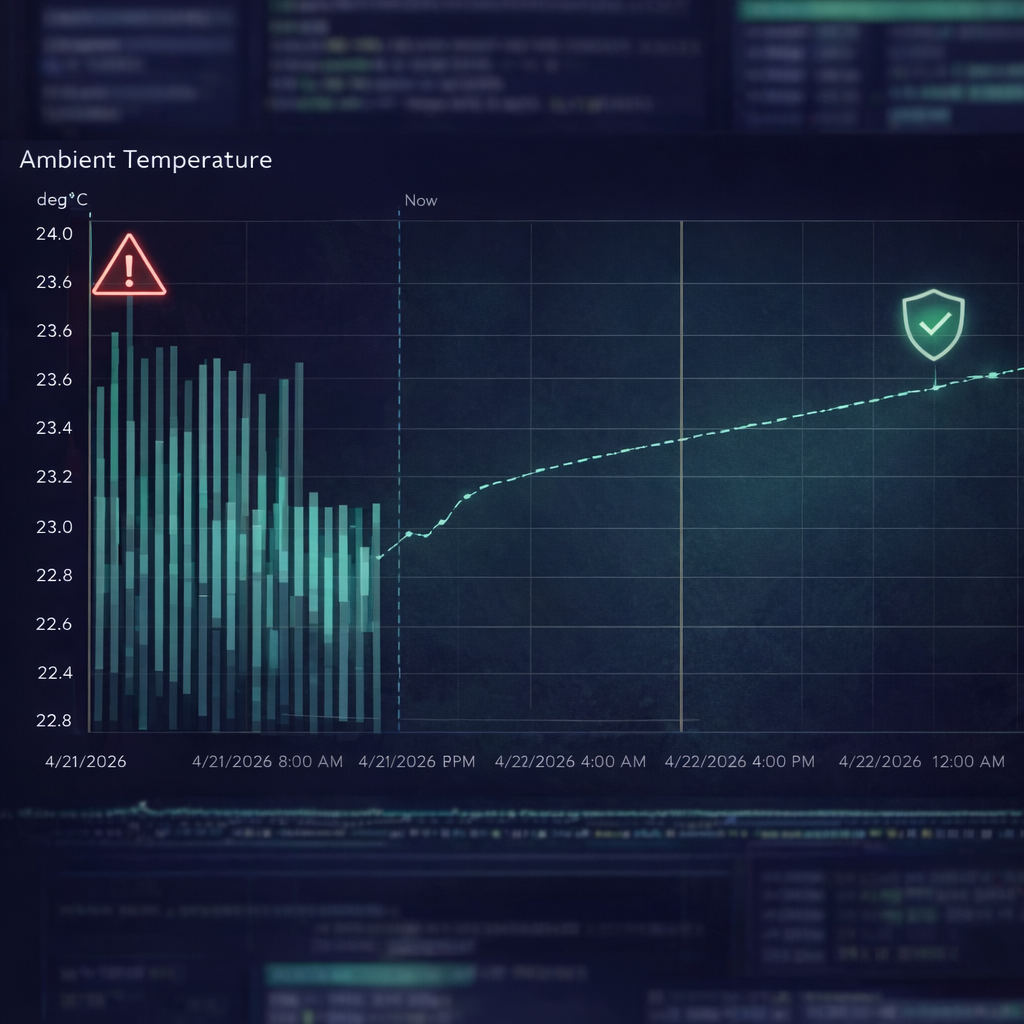
    Is the service reliable over time?

    Modern operations demand more than hindsight. Predictive analytics are essential when managing environmental constraints, cloud costs, and finite bandwidth in live media workflows.

    Contribution xOps - Trend prediction

    Automate – What actions can we take?

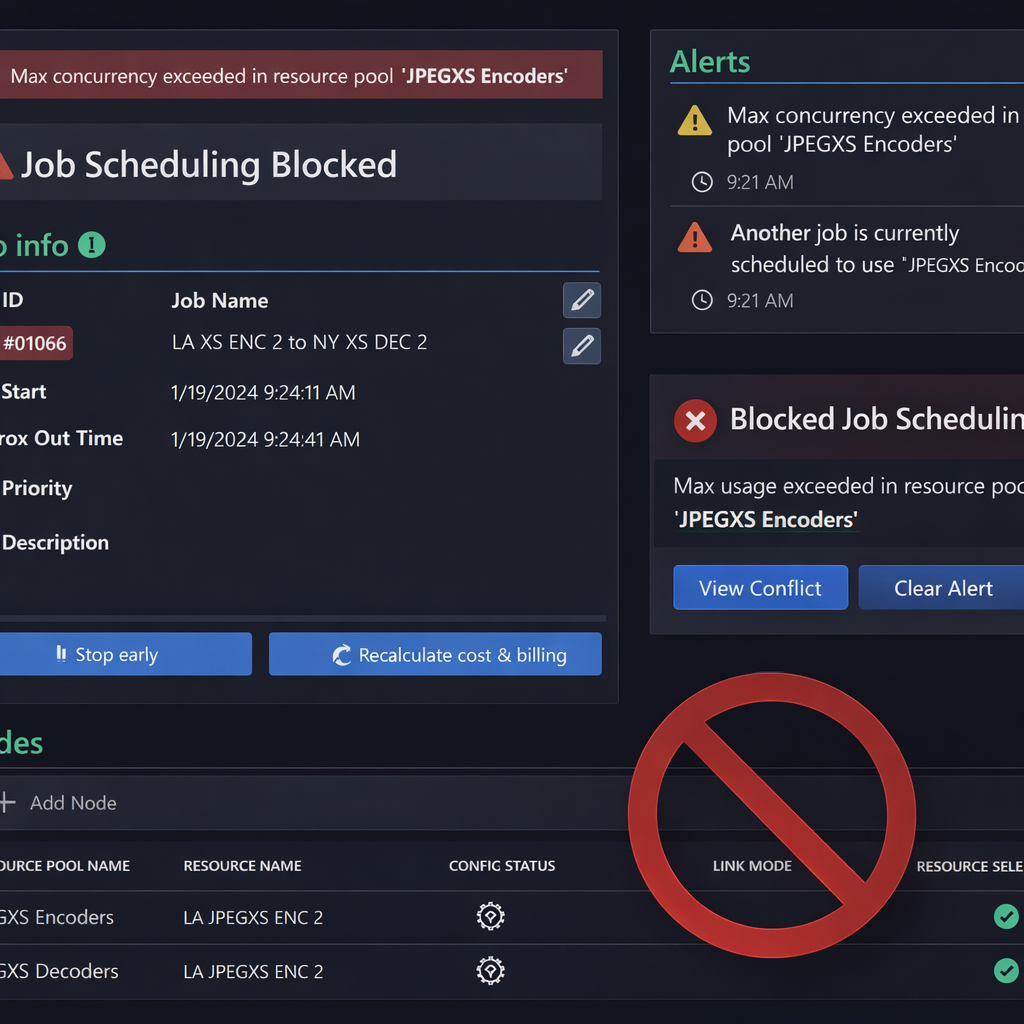
    Observability alone tells you what failed; an end‑to‑end xOps stack ensures most issues are both identified and resolved automatically. Some examples are:

    SymptomLikely CauseWhat Software Can Do
    No input lockSource offlineAlert + block job scheduling
    Freeze frameUpstream encoder issueTrigger failover
    SDI output lossLocal IO issueFlag service degraded

    Alert + block job scheduling

    Contribution xOps - Automate

    Orchestrate – Let software decide what happens next

    Monitoring and automation can work in isolation—but they don’t scale. True lights‑out operations require orchestration built on an integrated foundation.

    Ad-hoc workflows

    Contribution platforms (e.g., Techex) that take an API‑first design enable workflows—routing, configuration, and service control—to be managed entirely in software, rather than through device‑level or out‑of‑band interfaces.

    A vendor‑agnostic control plane (e.g., DataMiner) sits above these platforms, consolidating control and orchestration into a single interface. This allows operators to act across the full service chain—instead of managing each device in isolation.

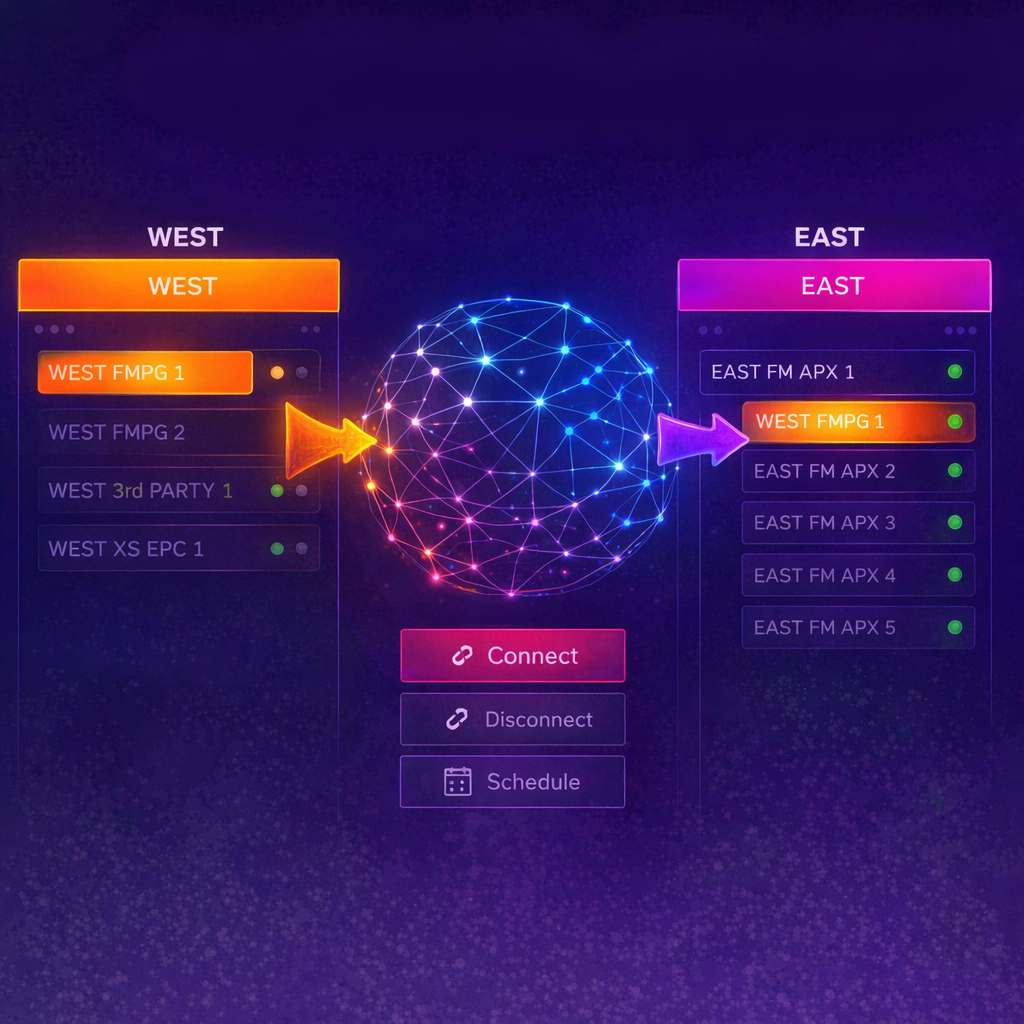
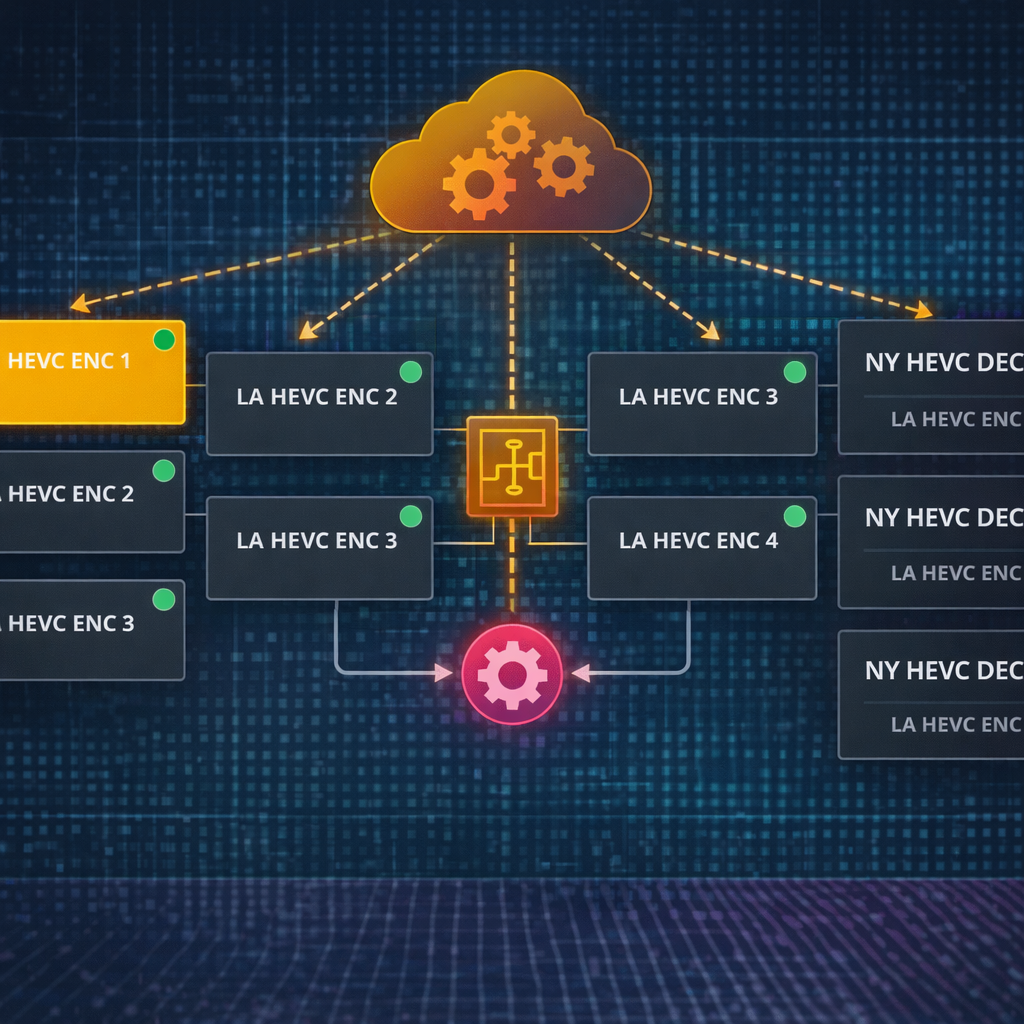
    In practice, operators can connect sources to destinations (encoder → decoder) across multiple nodes directly from the control plane stack. But the real value comes from extending workflows together with business needs using the same approach.

    For example, a live feed encoded on a contribution platform (e.g., LTN) can be routed into a cloud transport (e.g., AWS MediaConnect), validated with network KPIs, and then triggered downstream into a production workflow (e.g., Grass Valley AMPP)—all orchestrated from the same control plane. Operators don’t switch tools; the workflow remains continuous, observable, and controllable end‑to‑end.

    Contribution xOps - Orchestrate

    Scheduled workflows

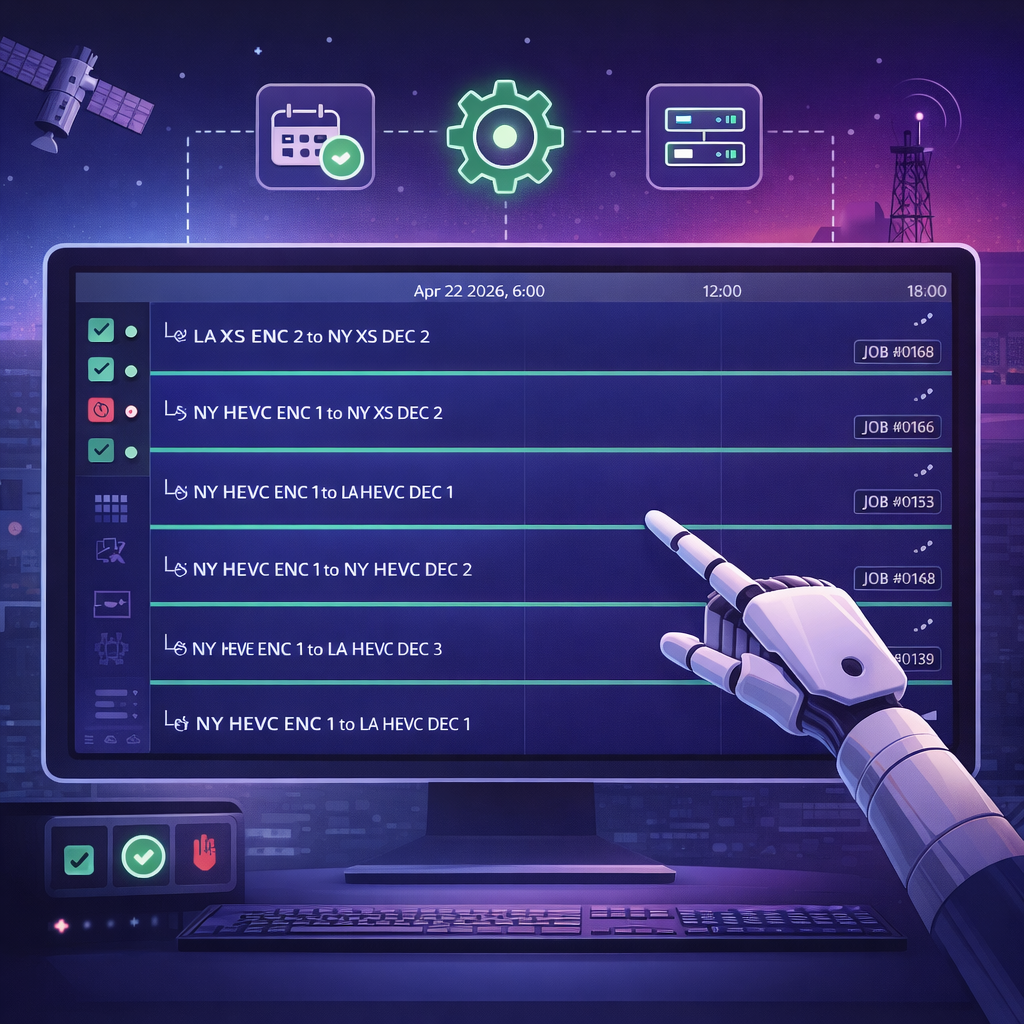
    Scheduling is fundamental to automation and reliable, lights‑out operations.

    In practice, however, media workflows quickly outgrow simple schedulers. Jobs vary by event, recur unpredictably, and depend on coordinated use of encoders, networks, cloud services, and human operators.

    To manage this complexity, you need a control plane that treats these components as part of a single, unified workflow.

    This becomes especially critical in cloud environments, where resources must be provisioned just‑in‑time and released immediately after execution to control cost.

    In this model, resources can span multiple vendors and technologies—but are abstracted behind a common control plane that represents the digital twin of the operation. This allows workflows to be scheduled and executed consistently, independent of the underlying infrastructure.

    Contribution xOps - Schedule

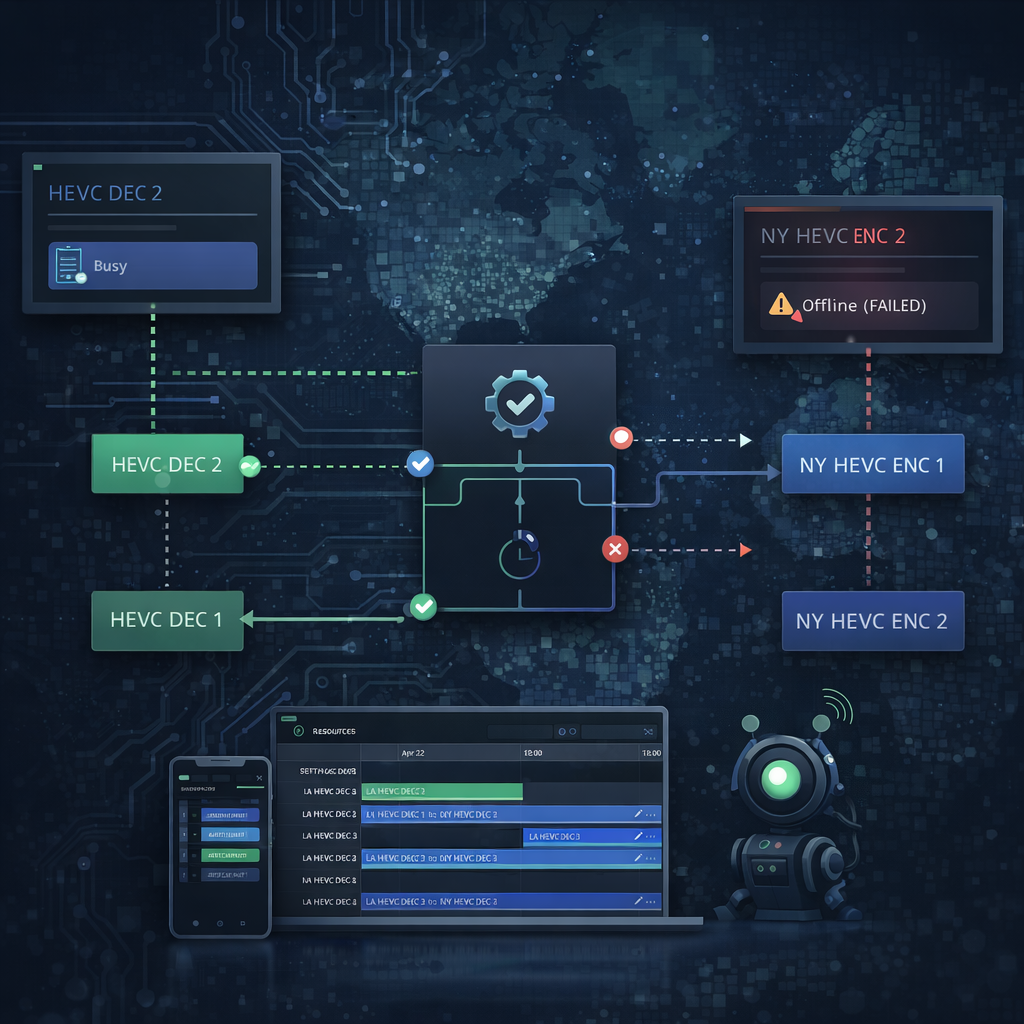
    State-aware workflows

    As operations scale, Media workflows rely on shared resources, recurring jobs, and strict timing constraints that can’t be managed in isolation.

    A control plane must be state‑aware—tracking resource current and future commitments—so capacity is allocated when needed and released immediately after.

    This level of orchestration is essential for efficiency and reliability at scale.

    Contribution xOps - State aware workflow

    Wait! What about AI?

    AI is being pitched as a silver bullet for media operations—but intelligence only delivers value when it operates within real‑time context and domain awareness.

    Professional platforms, as the ones referenced in this article, already embed an understanding of workflows, failure modes, and operational intent. That makes them far better foundations for AI than generic tools trying to learn broadcast behavior after the fact.

    A common anti‑pattern is exporting raw telemetry from an xOps stack into a data lake and expecting downstream AI to “figure it out.” Historical data has its place, but it lacks the immediacy and context required for live operations.

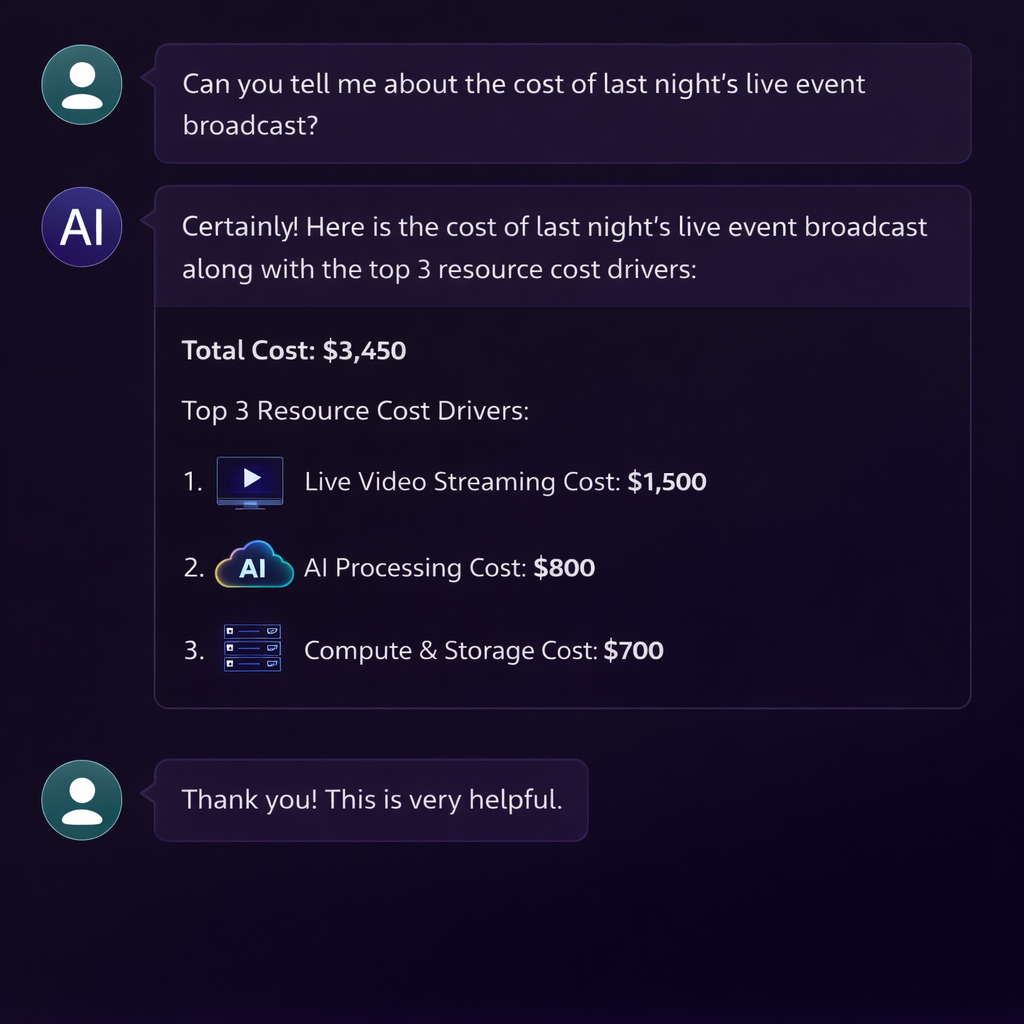
    The real opportunity is at the control plane. By integrating AI agents directly into live systems—where they can access telemetry, service state, and automation hooks—AI can move from passive insight to active control.

    In an agentic model, the Control Plane AI agent becomes an operational interface: answering real‑time questions, supporting operators, and enabling external agents (such as FinOps) to interact directly with the live system.

    Contribution xOps - AI

    Vendor-agnostic doesn’t mean vendor-ignorant

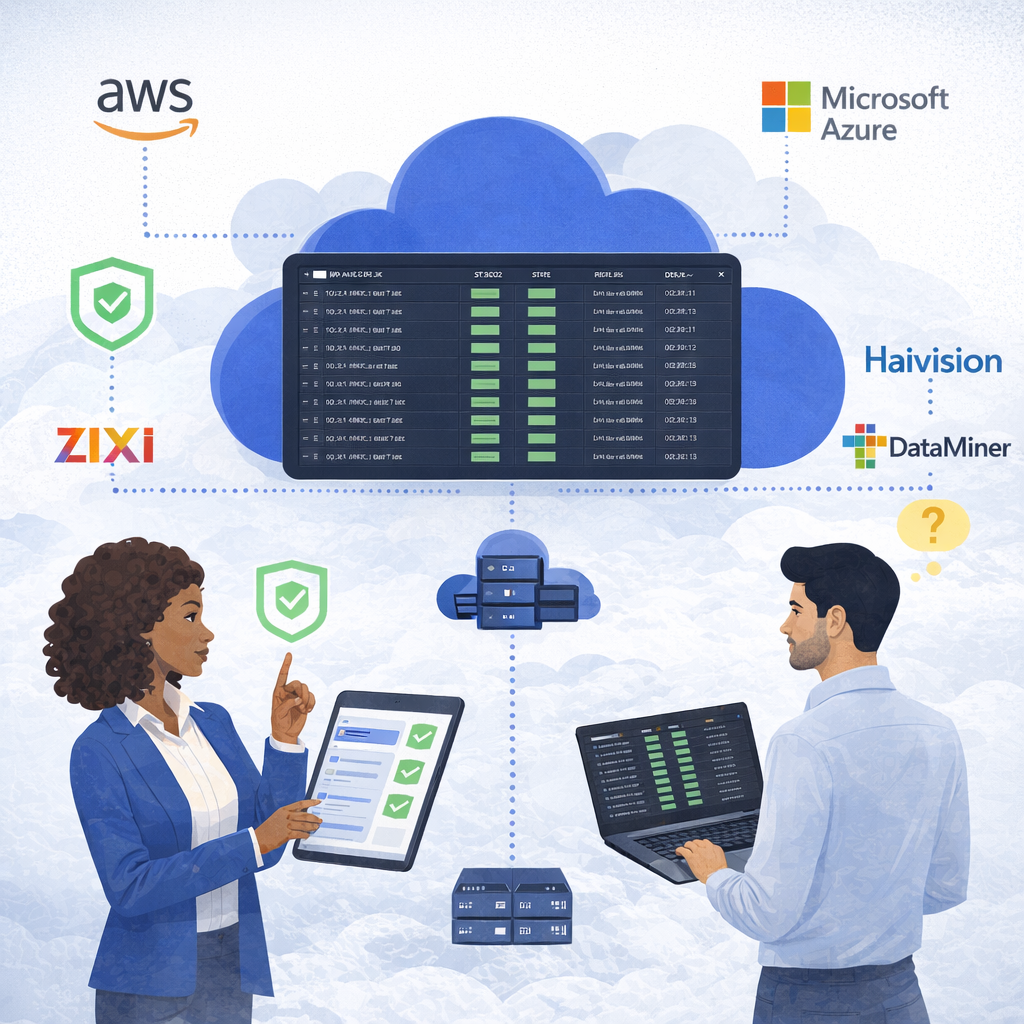
    Business objectives should drive vendor choices, not the other way around. Modern broadcast architectures are inherently multi‑vendor, but that doesn’t mean all platforms are interchangeable. Best‑of‑breed systems earn their place by doing one thing exceptionally well.

    Proven contribution platform (e.g., HaiVision) come with maturity and field‑tested performance, which translates to operational predictability. The job of the technology decision maker is to ensure selected platforms deliver today and into the future. Cost efficiency needs to be assessed for CAPEX and OPEX which requires careful analysis and business strategy understanding.

    The same principle applies to operational control planes. xOps enabling platforms (e.g., DataMiner) are not just solving today’s monitoring or alerting needs, they are designed to evolve with the business as workflows become more automated, more interconnected, and increasingly software‑defined.

    Contribution xOps - Vendor agnostic

    Takeaways

    Media reliability is an operational systems problem—not a codec problem.

    Success or failure is determined by visibility, correlation, automation, and control across the workflow, not by compression settings in isolation.

    Best‑of‑breed media platforms only scale with an external control plane.

    Specialized systems in contribution and transport platforms reach their full value when orchestration, monitoring, and automation are handled independently and holistically.

    Organizations that treat contribution as a service, not equipment, move faster and fail less.

    Abstracting infrastructure into schedulable, observable services enables resilience, repeatability, and continuous improvement at scale.


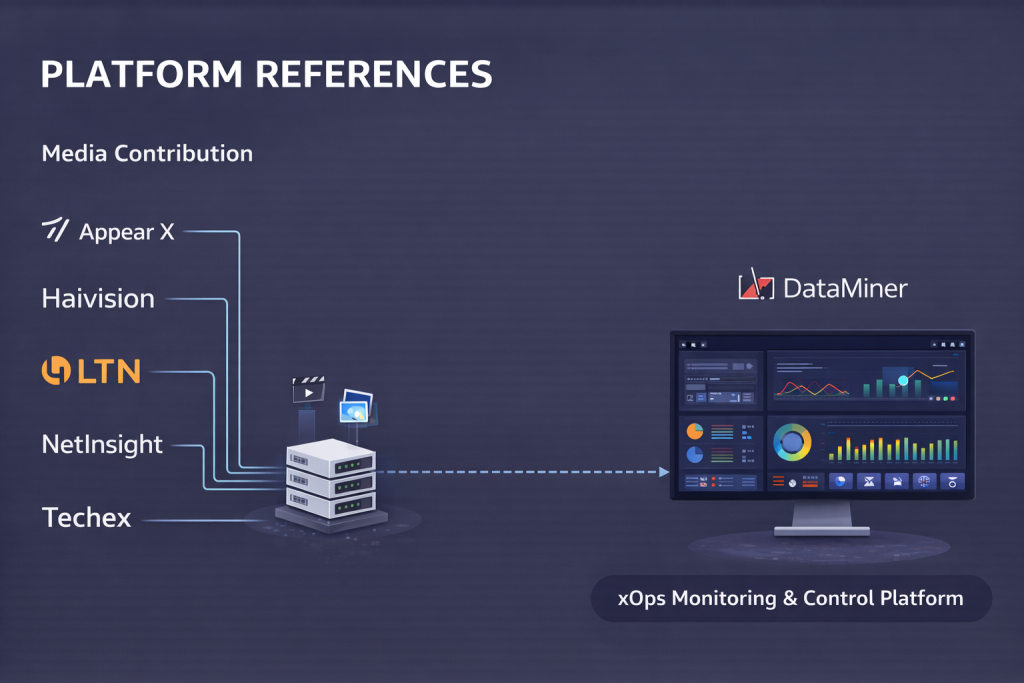
    Platform References

    Disclaimer: Open xOps does not endorse or recommend specific products or platforms. The selection of technology solutions remains the responsibility of the technology advisor or organization, who must evaluate and choose the options that best align with their specific business objectives and operational requirements.

    Media Contribution

    xOps Monitoring & Control Plane

    Contribution xOps - Platforms

Learn more. Earn more. Always free.

© 2026 Open xOps