
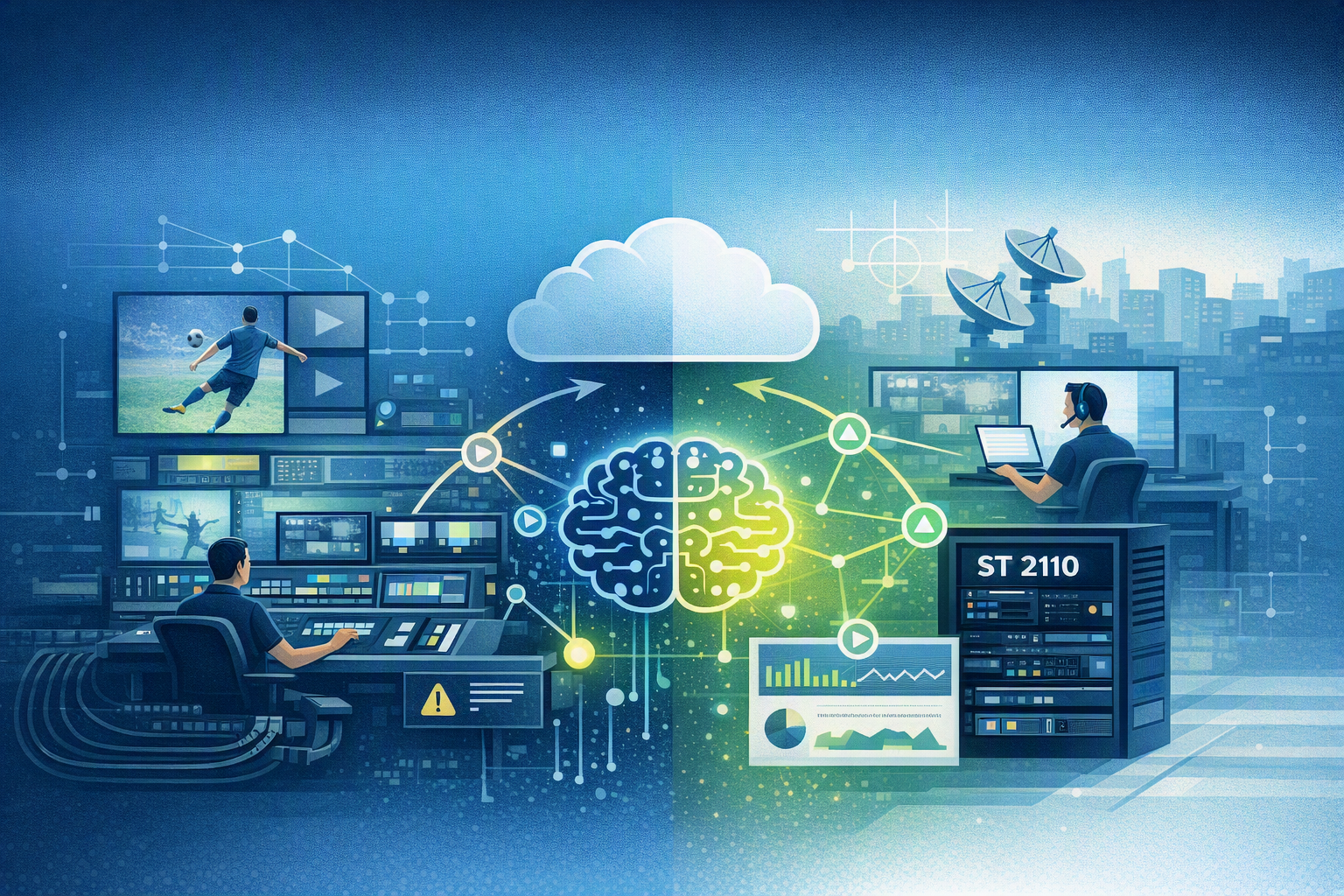
Watch article preview here: Hybrid SDI-IP Live Production – A Software Perspective.mp4
A practical breakdown of how a hybrid SDI/IP live production facility operates, covering acquisition, IP transport, switching, monitoring, orchestration, and cloud integration using real-world technologies and workflows.
The Problem Every Broadcaster Knows
You’re running a live sports production. Camera feeds are flowing, the director is calling cuts, replay operators are queuing highlights, and somewhere in the chain a timing issue silently impacts a stream. Operators scramble across multiple systems while remote production teams lose visibility.
This is one of the primary drivers behind the industry’s transition from traditional SDI environments to SMPTE ST 2110 IP production. Most broadcasters make this transition gradually, operating hybrid environments for years while balancing legacy infrastructure with newer IP workflows.
The challenge is not simply transporting video. It is creating operational visibility, orchestration, reliability, and scalability across multiple technology domains.
The Six Workflow Pillars of a Hybrid Production Facility
A modern hybrid production environment typically consists of six major domains:
- Acquisition
- SDI-to-IP Migration
- IP Media Network
- Live Production & Switching
- Monitoring & Multiviewing
- Control, Orchestration & Cloud Integration
The specific technologies referenced throughout this article are representative examples of platforms commonly used to implement these functions. The architectural patterns apply broadly across the industry.
1. Acquisition: Where the Signal Begins
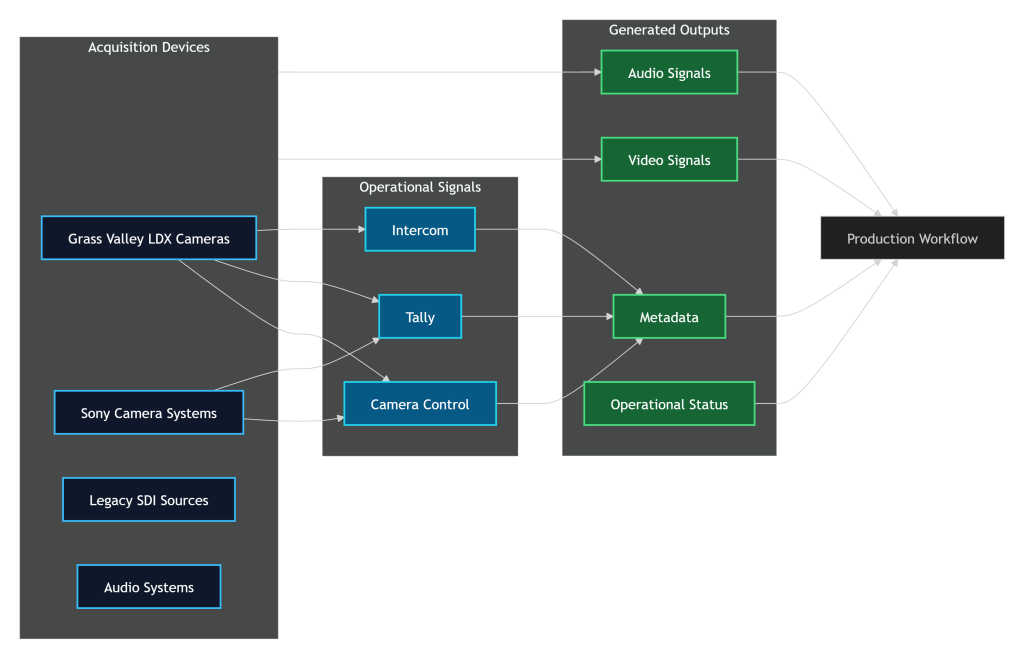
The acquisition layer captures live video, audio, tally, intercom, and camera control information.
In hybrid production environments, cameras such as Grass Valley LDX may serve as primary acquisition devices, often paired with systems such as the Grass Valley HPE Hybrid Power Extender.
Legacy SDI sources, including Sony camera systems and other traditional broadcast equipment, are also commonly integrated into the broader workflow.
Regardless of vendor, the acquisition layer is responsible for generating the media, metadata, and operational signals that drive the entire production chain.
For software teams, this means supporting multiple signal formats, control protocols, metadata models, and operational states.
2. The SDI-to-IP Migration Layer
One of the most important architectural components in a hybrid facility is the gateway between SDI and IP workflows.
In these facilities, platforms such as EVS Neuron Bridge and EVS Neuron Convert provide the SDI-to-IP gateway function by transforming traditional SDI signals into SMPTE ST 2110 media flows and handling media format conversions.
The broader architectural function is media interoperability. These systems allow content to move between legacy infrastructure and modern IP workflows without requiring wholesale replacement of existing equipment.
The operational impact is significant. A signal that was once tied to a dedicated destination becomes a routable resource available throughout the facility.

3. The Core IP Media Network
The heart of a modern IP facility is the media transport network.
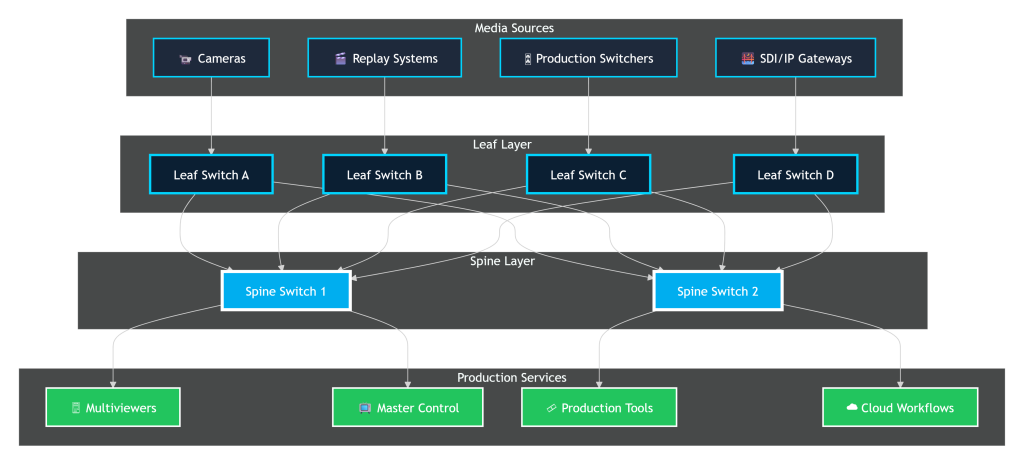
Many modern facilities implement spine-leaf media networks using platforms such as the Arista switching and routing family, providing scalable multicast transport, resiliency, and predictable performance.
The important concept is not the switch vendor. It is the architectural shift that occurs when the network becomes the media routing platform.
Routing policies, multicast management, timing synchronization, redundancy, and telemetry become core operational disciplines. For software engineers, the network is no longer supporting infrastructure. It becomes a critical production dependency.
4. Live Production & Switching
The production layer is where live content is assembled into the final program output.
This domain typically includes production switching, replay operations, clip management, graphics insertion, and content distribution.
In a typical hybrid production workflow:
- A production switcher such as the Grass Valley K-Frame XP may serve as the primary live switching platform.
- Replay systems such as EVS XT VIA may provide recording, instant replay, and clip playback capabilities.
- Production asset management platforms such as EVS IP Director may support clip search, playlist creation, and replay orchestration.
These products represent specific implementations of broader production functions that exist in every live broadcast environment.
From a software perspective, this is where latency, resiliency, state management, and operational coordination directly influence on-air outcomes.

5. Monitoring & Multiviewing
Operational visibility is essential in IP production environments.
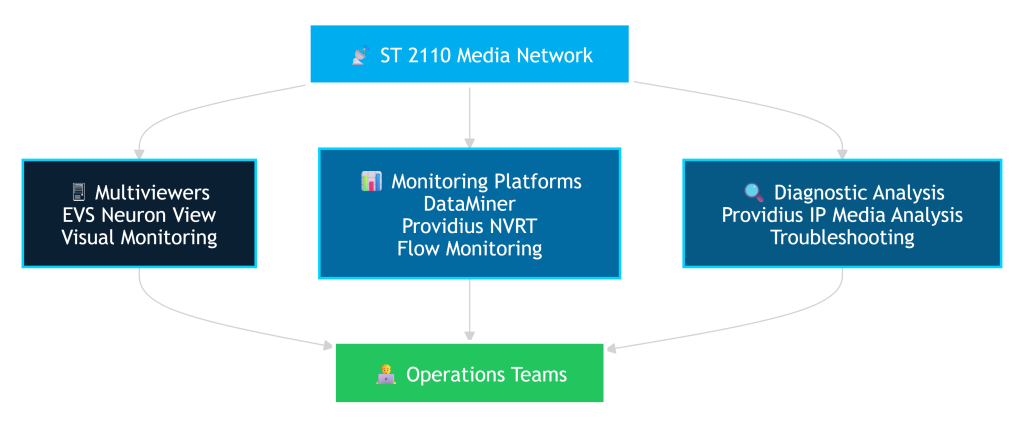
Facilities deploy multiviewers, media monitoring systems, timing analytics platforms, and deep packet inspection tools to provide real-time insight into media health.
In many ST 2110 environments:
- Multiviewer platforms such as EVS Neuron View provide visual monitoring across many media flows.
- Monitoring systems such as DataMiner and Providius NVRT track ST 2110 flow performance.
- Diagnostic platforms such as Providius IP Media Analysis provide advanced media analysis and troubleshooting capabilities.
Together, these types of platforms form the observability stack of the broadcast environment, providing visibility into packet loss, latency, jitter, timing synchronization, and media service health.
6. Control & Orchestration
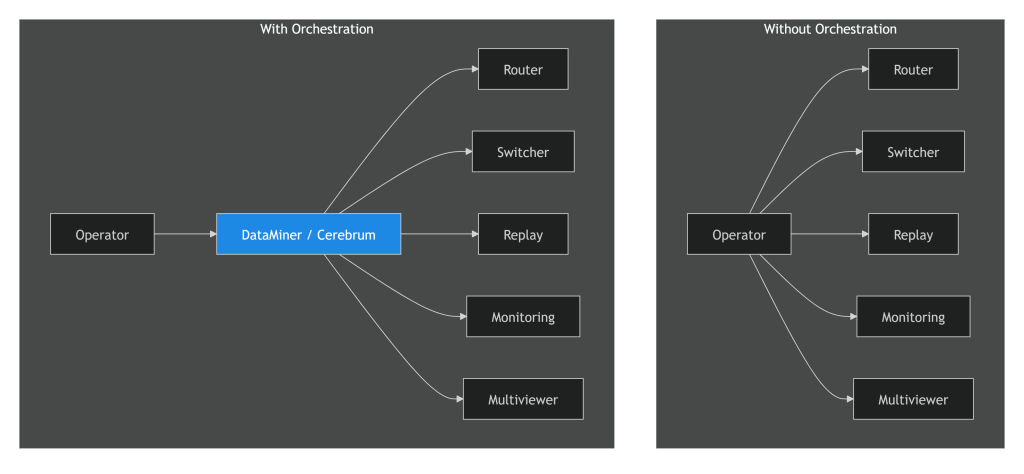
An orchestration layer is often the most important software platform in the facility.
Rather than requiring operators to work across dozens of independent systems, orchestration platforms provide a unified operational interface for routing, monitoring, switching, replay, multiviewing, and workflow automation.
In typical multi-vendor broadcast environments, platforms such as Cerebrum and DataMiner provide centralized operational control across multiple vendors and technology domains.
The broader architectural lesson is that orchestration becomes increasingly important as system complexity grows. It transforms isolated technologies into a coordinated operational platform.
7. Cloud Production & Remote Workflows
Cloud platforms extend production capabilities beyond the physical facility.
Modern environments increasingly support:
- REMI workflows
- Remote operators
- Distributed production teams
- Cloud replay
- Cloud graphics
- Elastic processing resources
In many hybrid production architectures, platforms such as Grass Valley AMPP provide cloud production capabilities, while edge systems such as AMPP Edge XL facilitate connectivity between on-premises infrastructure and cloud resources.
The technology itself is only part of the story. The architectural goal is seamless movement of media, operational workflows, and production resources between edge and cloud environments.

The Five Dependencies That Can Break Everything
- Timing Synchronization: ST 2110 environments depend on accurate timing.
- Network Infrastructure: The IP fabric becomes the routing foundation.
- Media Gateways: Platforms such as EVS Neuron bridge SDI and IP workflows.
- Orchestration Platforms: Systems such as Cerebrum and DataMiner coordinate operations across vendors.
- Cloud Connectivity: Platforms such as AMPP and edge integration services enable hybrid production workflows.
What This Means for Software Engineers
A modern broadcast facility is not defined by a particular vendor stack. It is defined by how acquisition, networking, production, observability, orchestration, and cloud services work together.
The technologies discussed in this article provide concrete examples of how those architectural functions can be implemented. Grass Valley, EVS, Arista, Providius, Cerebrum, and DataMiner each contribute capabilities that exist in many forms across the industry.
Key takeaways include:
- Observability is non-negotiable.
- Orchestration scales operations.
- The network is now core infrastructure.
- Cloud integration is a workflow, not a feature.
- Individual products should be viewed as implementations of broader architectural functions.
Bring Focus Here
If you’re building or evolving a hybrid production environment, start by understanding the architectural requirements before evaluating technologies.
Define your observability requirements, document your timing model, establish orchestration boundaries, and determine how cloud workflows fit into your production strategy.
Consider implementing an end-to-end observability and orchestration platform, such as DataMiner, above the individual technology domains. Many Tier 1 broadcasters adopt this approach because it simplifies the integration of new technologies and reduces operational silos. While vendors often provide their own monitoring and control tools, a centralized platform helps create a unified operational model across the entire ecosystem.
Technology vendors will continue to evolve. The architectural principles behind reliable broadcast operations remain the same.
Building software solutions in Media & Broadcast, Satellite, Telecom, or Smart Ecosystems?
Follow Open xOps for articles, courses, and insights designed for software engineers and technology leaders building and operating complex interconnected systems.
